


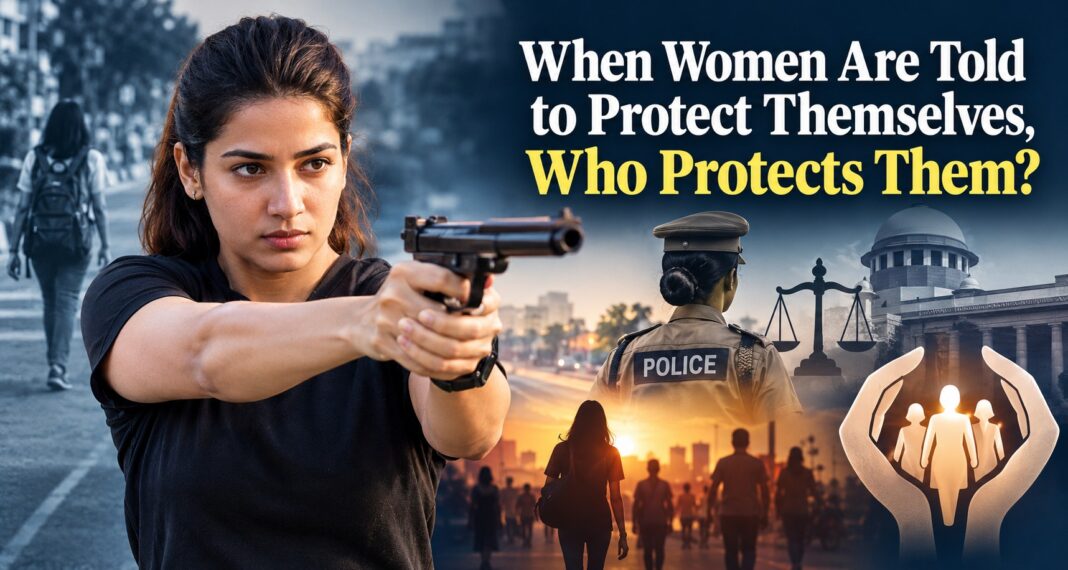

The recent video by Khushboo Patani, former Indian Army officer and sister of actor Disha Patani, has opened a conversation that is far bigger than an air pistol. Following public outrage over a recent harassment and assault case in Bihar’s Jamui district, Patani urged women to consider learning how to use a CO₂ air pistol for self-defence. She demonstrated the equipment, emphasised responsible handling and training, and told women not to depend entirely on others for their safety.
At first glance, the message appears empowering. A woman learning to defend herself can certainly be understood as an expression of agency. But ethically, the statement raises a much more uncomfortable question: when women are repeatedly told to protect themselves, are we empowering them or quietly transferring the responsibility for public safety from society and the State onto the potential victim? That distinction matters.
Self-defence is not a new idea. Women have every moral right to acquire skills that can help them respond to danger. Physical fitness, situational awareness, emergency communication, basic self-defence training and confidence can all contribute to personal safety. Patani’s emphasis on training and responsible handling is therefore an important part of her message. Reports of her video indicate that she specifically advised women to receive professional training rather than simply acquiring equipment without understanding it.
Yet, the problem begins when self-defence becomes a substitute for institutional responsibility. A woman walking home should not have to calculate whether she has sufficient equipment to defend herself. A student returning from college should not have to live with the assumption that danger is inevitable and that she alone must prepare for it. A woman travelling by public transport should not have to carry the moral burden of preventing violence committed by someone else. The perpetrator chooses violence. The victim does not. I believe that this simple moral distinction is frequently lost in conversations about women’s safety.
India already has criminal laws addressing sexual harassment, assault, stalking and other offences against women. The Bharatiya Nyaya Sanhita specifically criminalises sexual harassment, assault intended to outrage a woman’s modesty, stalking and related offences. The existence of laws, however, is not identical to the experience of safety. Between legislation and lived reality stand policing, investigation, judicial processes, social attitudes, institutional accountability and the willingness of witnesses and communities to intervene. This is where the discussion needs to move.
An air pistol may provide some individuals with a psychological sense of preparedness. But preparedness is not the same as protection. A weapon, particularly one designed to resemble a conventional firearm, introduces another set of moral questions. What happens when an attacker is not deterred? What happens when a situation escalates? What happens when the object is mistaken for a real firearm? What happens if it is taken from the person carrying it? What happens when someone without adequate training attempts to use it under extreme fear? These are not arguments against women’s agency. They are arguments for responsible agency.

There is also a significant danger in reducing a complex social problem to an individual consumer solution. If the public conversation becomes, “Buy an air pistol and protect yourself,” the structural problem can disappear from view. Violence against women is not fundamentally caused by women’s inability to defend themselves. It is caused by people who choose to violate others and by social and institutional conditions that can allow such behaviour to continue. That is why the phrase “don’t depend on anyone” deserves examination.
A safe society should enable women to depend on functioning institutions when they need them. Police should respond efficiently. Schools and universities should have effective safeguarding systems. Public transport should have meaningful safety mechanisms. Workplaces should take complaints seriously. Families and communities should support survivors rather than questioning their behaviour. Courts should provide accessible justice. Bystanders should understand that silence is not neutrality when someone is being harmed. The ultimate goal should not be to create a society in which every woman becomes proficient at handling a weapon. The goal should be a society in which carrying such an object is not perceived as necessary for ordinary life.
Patani reportedly referred to air pistols costing around ₹60,000 to ₹70,000 and encouraged women interested in them to seek training at shooting ranges. But how many women can afford that equipment and the accompanying training? A financially inaccessible safety strategy cannot become a universal answer to women’s insecurity. One must also make a distinction between empowerment and militarisation. Empowerment gives people greater capacity to make informed choices. Militarisation normalises the idea that ordinary citizens must increasingly prepare themselves for violence. A society that continuously responds to insecurity by putting more weapons into individual hands may address one dimension of fear while creating other risks.
Therefore, women should be encouraged to develop confidence, awareness and legitimate self-defence skills if they choose to do so. At the same time, society must refuse to treat such preparation as a replacement for institutional responsibility. The conversation should not be “women need weapons because the system cannot protect them.” It should be: women have the right to protect themselves, and the State has the responsibility to build conditions in which they do not have to live in fear. That is a much more demanding standard.
Patani’s intervention has therefore done something valuable, even beyond the specific question of the CO₂ air pistol. It has forced a neglected question into public conversation: What does it mean for a woman to feel safe in her own country? The answer cannot simply be a weapon in her hand. Safety is ultimately a social achievement. It is created when laws are enforced, institutions respond, perpetrators are held accountable, public spaces are designed responsibly, communities reject misogyny, and women can move through society without constantly calculating risk. Self-defence can be one part of that conversation. It must never become society’s excuse for avoiding the larger one.